
Headnotes Arena: a blinded expert evaluation of KURAL against the human gold-standard journal and GPT state of the art
In a blinded tournament, 33 lawyers ranked jhana’s headnotes first, ahead of the editors of Supreme Court Cases and GPT-4o
In 1976 William Landes and Richard Posner treated1 precedent as “a capital stock that yields a flow of information services.” A judgment adds to that stock only if the next reader can find it and use it. At the Madras High Court, 54.8%2 of advocates told a 2020 survey that they subscribed to no law reporter or online database. The headnote is what makes a judgment meaningful to that reader: the reporter’s statement of the acts in question, the issue, and the holding. The standard for headnotes in India is the Supreme Court Cases (SCC) reporter, written by legal editors, sold by subscription, and published months after a judgment is delivered. jhana’s pipeline adds tagging, search indexing, a table of contents, and simple-language summaries.
In June 2025 we asked whether an AI can write headnotes that lawyers actually prefer, and we put the question the way the field ranks language models: a blinded arena. Thirty-three alumni and students of the National Law School read 12 Supreme Court judgments and, for each, three headnotes stripped of all branding: SCC’s, GPT-4o’s, and KURAL’s, jhana’s headnote pipeline.
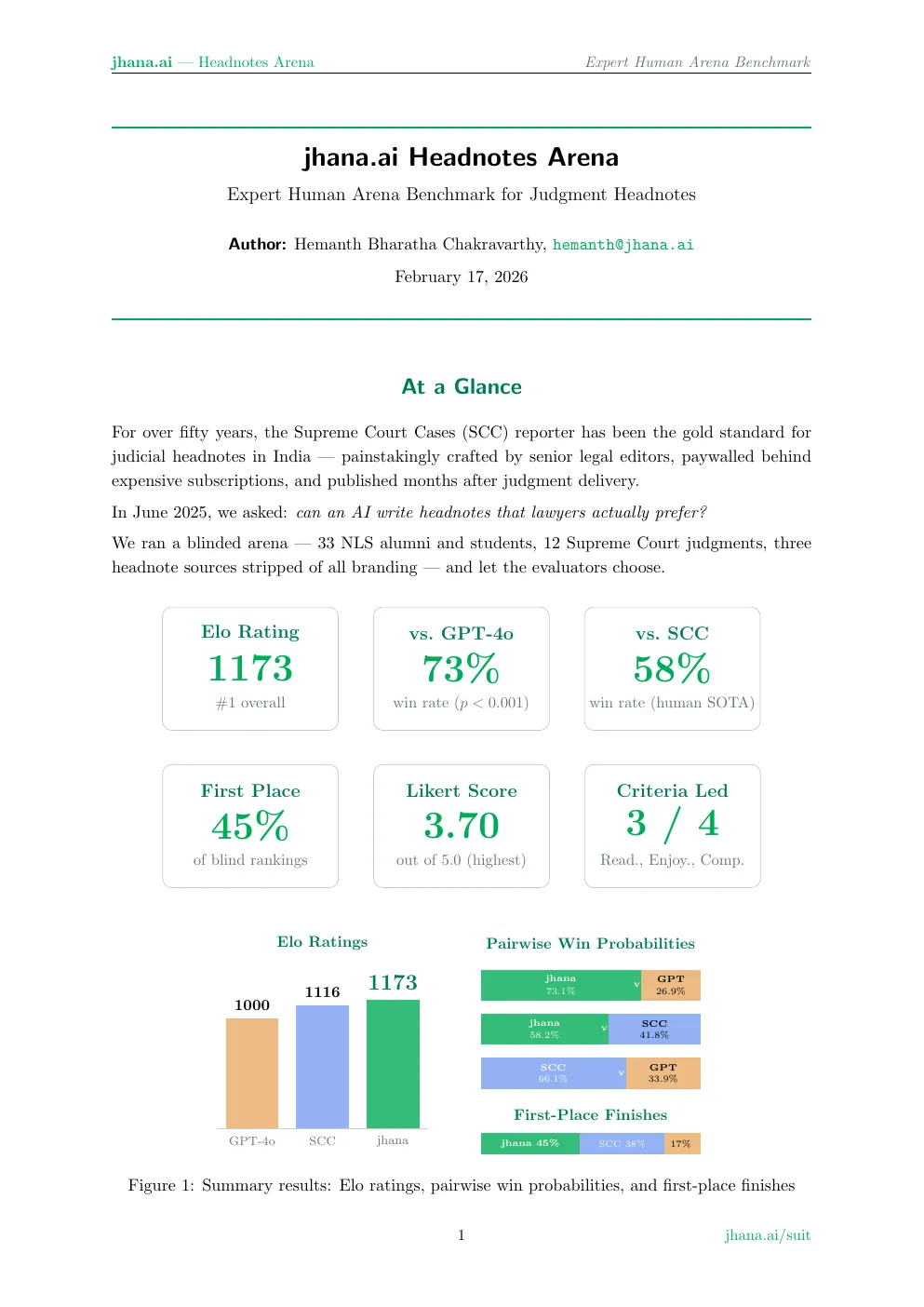
KURAL ranked first, at Elo 1173 to SCC’s 1116 and GPT-4o’s 1000. The rest of this note shows the working: how a ranking of three becomes pairwise votes, how a Bradley-Terry model turns votes into a rating, what a 57-point gap is worth in wins, and what a panel of this size can resolve.
KURAL ranks first: Elo 1173, to SCC’s 1116 and GPT-4o’s 1000.
Each square is one lawyer’s ranking of the three headnotes for one judgment, colored by its first choice. Point at a kind of ranking to see the three votes it casts. Uncheck it, and the model is fitted again without it.
From votes to ratings
Each evaluator ranked the three headnotes for a judgment, ties permitted. A ranking of three decomposes into three pairwise votes, and a tie contributes half to each side. Counting who wins each pairwise contest is Condorcet’s3 method. Across 345 rankings KURAL wins both of its contests, which makes it the Condorcet winner.
To put three contests on one scale we fit4 the Bradley-Terry model, which Zermelo derived5 for chess tournaments in 1929. Each system j gets one number, its strength θj, and the probability that a judge prefers a to b depends only on the difference between their strengths:
P(a ≻ b) = 1 / (1 + exp(−(θa − θb)))
In words: equal strengths are a coin flip, and each additional unit of difference multiplies the odds of being preferred by e, about 2.7. The strengths are chosen to make the votes we observed as probable as possible, which is to maximize
ℓ(θ) = Σa≠b wab · log P(a ≻ b)
where wab is the number of votes for a over b. The fit gives θ̂ = 0.998 for KURAL and 0.666 for SCC, with GPT-4o fixed at 0.
Elo6 is the same model on the chess player’s scale, where 400 points mean ten-to-one odds:
Eloj = 1000 + (400 / ln 10) · θj
That turns 0.998 into 1173 and 0.666 into 1116. The LMSYS Chatbot Arena ranks7 language models this way, and moved from updating Elo one game at a time to this maximum-likelihood fit for stability. Our three systems are static, so we fit every vote at once.
A 57-point gap is a 58% preference. A 173-point gap is 73%.
The share of judges who prefer the higher-rated headnote, by Elo gap. Move the gap to read any point on the curve.
| Bradley-Terry leaderboard | Elo | v. jhana | v. SCC | v. GPT-4o |
|---|---|---|---|---|
| 1. jhana KURAL | 1173 | — | 58.2% | 73.1% |
| 2. SCC, human SOTA | 1116 | 41.8% | — | 66.1% |
| 3. GPT-4o, LLM SOTA | 1000 | 26.9% | 33.9% | — |
Each cell is the probability that a randomly selected judge prefers the row’s headnote to the column’s.
The model has two free numbers and three contests to reproduce. It predicts 73.1%, 58.2%, and 66.1%. The raw vote shares are 75.2%, 56.1%, and 63.9%, so every residual is under 2.5 points. In outright three-way rankings KURAL is the winner 45.2% of the time, to SCC’s 38.3% and GPT-4o’s 9.6%.
Scores
Before ranking, each evaluator scored every headnote from 1 to 5 on comprehensiveness, accuracy, readability, and enjoyability. We model a score as
Sijkc = μjc + αi + γk + εijkc
In words: the score that judge i gives system j on judgment k and criterion c is the system’s true quality on that criterion, plus how generous the judge is, plus how tractable the judgment is, plus noise. Every judge scored all three systems on the same judgment, so the difference between two systems cancels the judge and the judgment, and a paired t-test on those differences tests the quality gap alone.
| Mean score, 1–5 | jhana | SCC | GPT-4o |
|---|---|---|---|
| Comprehensiveness | 3.76 | n.s. | 3.21*** |
| Accuracy | 3.57 | 3.83* | 2.93*** |
| Readability | 3.77 | 3.28** | 3.51* |
| Enjoyability | 3.71 | 3.03*** | 3.38** |
| Overall | 3.70 | 3.48 | 3.26 |
Stars mark a significant difference from jhana on that criterion (paired t-tests, n = 115): *** p < 0.001, ** p < 0.01, * p < 0.05. n.s., not significantly different from jhana.
KURAL has the highest overall mean, 3.70 out of 5.0, to SCC’s 3.48 and GPT-4o’s 3.26. Against GPT-4o it leads on all four criteria. Against SCC the strongest signal is on the dimensions that matter most for practical use: readability (+0.47, p = 0.002) and enjoyability (+0.68, p < 0.001), whether a headnote is clear enough to parse under time pressure, structured enough to guide reasoning, and composed well enough that the reader trusts it. As effect sizes these are Cohen’s d of 0.46 and 0.62, which is to say that the average KURAL headnote is more enjoyable than about 73% of SCC’s.
The scores and the rankings are separate instruments, and they produce the identical leaderboard: jhana, SCC, GPT-4o.
Power
With 115 paired sets, the smallest deviation from 50% that a binomial test detects at α = 0.05 and power 0.8 is
δ = (1.96 + 0.84) · √(0.25 / n) ≈ 0.13
so this panel resolves win rates of about 63% and above. KURAL over GPT-4o (75.2%, p < 0.001) and SCC over GPT-4o (63.9%, p = 0.003) clear it. KURAL over SCC is directionally in jhana’s favor and under that threshold: jhana has reached parity with or exceeded the human gold standard. Resolving a 58% preference at the same power takes about 290 paired sets.
Tournament design
Law has no answer key for a headnote, so quality has to be elicited from experts, and how it is elicited decides what the answers mean. We borrowed from two literatures: the arenas that rank language models, and the older work on tournaments and preference elicitation in statistics and economics.
The design is within-subject and round-robin. Every evaluator saw all three systems on the same judgment, so each ranking is a paired comparison that holds the judge and the judgment fixed, and every system met every other on every ballot. The order of A, B, and C was randomized against position effects. The design, the tests, and the power analysis were fixed in a pre-analysis plan8 in March 2025, before a single vote.
Blinding also does the work of incentive design. With three or more alternatives, no reasonable voting rule is immune9 to strategic voting10. An evaluator who cannot tell which headnote is whose has nothing to vote strategically for. Evaluators received a gift card and a subscription, the same whatever they answered.
We asked for both cardinal scores and ordinal rankings because they fail differently. A 1–5 scale lets a judge say how much better, but each judge uses the scale in their own way. A ranking needs no shared scale, which is why paired comparison has been the instrument for subjective quality since Thurstone11. The design also provided for LLM judges, on the evidence that pairwise LLM judges agree with humans about 80%12 of the time; this report covers the human panel.
Benchmark and blinding
The 12 judgments were drawn from (2025) 3 SCC, the most recently published volume of the reporter at the time. These are not hand-picked landmark cases; they are simply the most recent reported decisions, spanning criminal, civil, commercial, and constitutional matters. They run from 4 to 62 pages, 24.6 on average.
SCC’s headnotes were retypeset in a generic format, preserving the aesthetic quality and formatting of the originals while stripping all brand identifiers. GPT-4o, the LLM SOTA at the time, was given the raw PDF judgment with standard prompting. KURAL was given the same PDF. The evaluators saw only “Headnote A,” “B,” and “C,” in randomized order.
The arena ran in person at jhana’s Bengaluru office on June 18, 2025, as part of RoboJuris. It produced 1,398 scores and 345 rankings across 115 paired sets.
KURAL
In September 2023 we fine-tuned Falcon to imitate finished headnotes inside a 2,048-token window. KURAL is the next architecture: fully agentic, with quasi-verification as its harness. Agents read the judgment in its native PDF, draft the headnote in the reporter’s format, and check the draft for errors before it is released. It is PDF to PDF.
GPT-4o trails KURAL by 17% on comprehensiveness and 18% on accuracy. KURAL is built on India’s National Legal Archive of 16M+ judgments, reads a judgment in its native PDF, where a text-only LLM loses the structure, and is calibrated to the headnote format that Indian courts use.
For the judiciary
KURAL produces headnotes that legal experts find more readable, more enjoyable, and equally comprehensive to the gold-standard SCC headnotes, at a fraction of the cost and time. That enables mass-scale headnote publication for nonreportable cases, public access to legal summaries without the paywall, and a faster turnaround from judgment delivery to published summary: more of the capital stock, paying out sooner. It is the work we did with the Madras High Court’s digital reporter.
After KURAL
And these results are already outdated. KURAL is the predecessor to Suit, and what you see in this report is a conservative lower bound on what jhana can do today.
SCC’s only advantage is accuracy (−0.27, p = 0.041), and that is the gap Suit is built to close. KURAL’s agents check their own draft. Suit decouples taste (penumbra) from reading (core), and certifies whether the minimum evidence was considered, under a bound that is proved and tight. That signal can be hill-climbed to fine-tune agents and harnesses for the law.
The report
Download the report (PDF, 19 pages).
Notes
- Landes and Posner, “Legal Precedent: A Theoretical and Empirical Analysis,” Journal of Law and Economics 19(2), 1976. ↩
- Vidhi Centre for Legal Policy, A Survey of Advocates Practicing before the High Courts, 2020. ↩
- Condorcet, Essai sur l’application de l’analyse à la probabilité des décisions rendues à la pluralité des voix, 1785. ↩
- Bradley and Terry, “Rank Analysis of Incomplete Block Designs: I. The Method of Paired Comparisons,” Biometrika 39, 1952. ↩
- Zermelo, “Die Berechnung der Turnier-Ergebnisse als ein Maximumproblem der Wahrscheinlichkeitsrechnung,” Mathematische Zeitschrift 29, 1929. ↩
- Elo, The Rating of Chessplayers, Past and Present, Arco, 1978. ↩
- Chiang et al., “Chatbot Arena: An Open Platform for Evaluating LLMs by Human Preference,” 2024. ↩
- Olken, “Promises and Perils of Pre-analysis Plans,” Journal of Economic Perspectives 29(3), 2015. ↩
- Gibbard, “Manipulation of Voting Schemes: A General Result,” Econometrica 41(4), 1973. ↩
- Satterthwaite, “Strategy-proofness and Arrow’s Conditions,” Journal of Economic Theory 10(2), 1975. ↩
- Thurstone, “A Law of Comparative Judgment,” Psychological Review 34(4), 1927. ↩
- Zheng et al., “Judging LLM-as-a-Judge with MT-Bench and Chatbot Arena,” NeurIPS 2023. ↩