
Portfolio Review Automation: SEBI PM Compliance + AML/CFT + DPDP Matrix
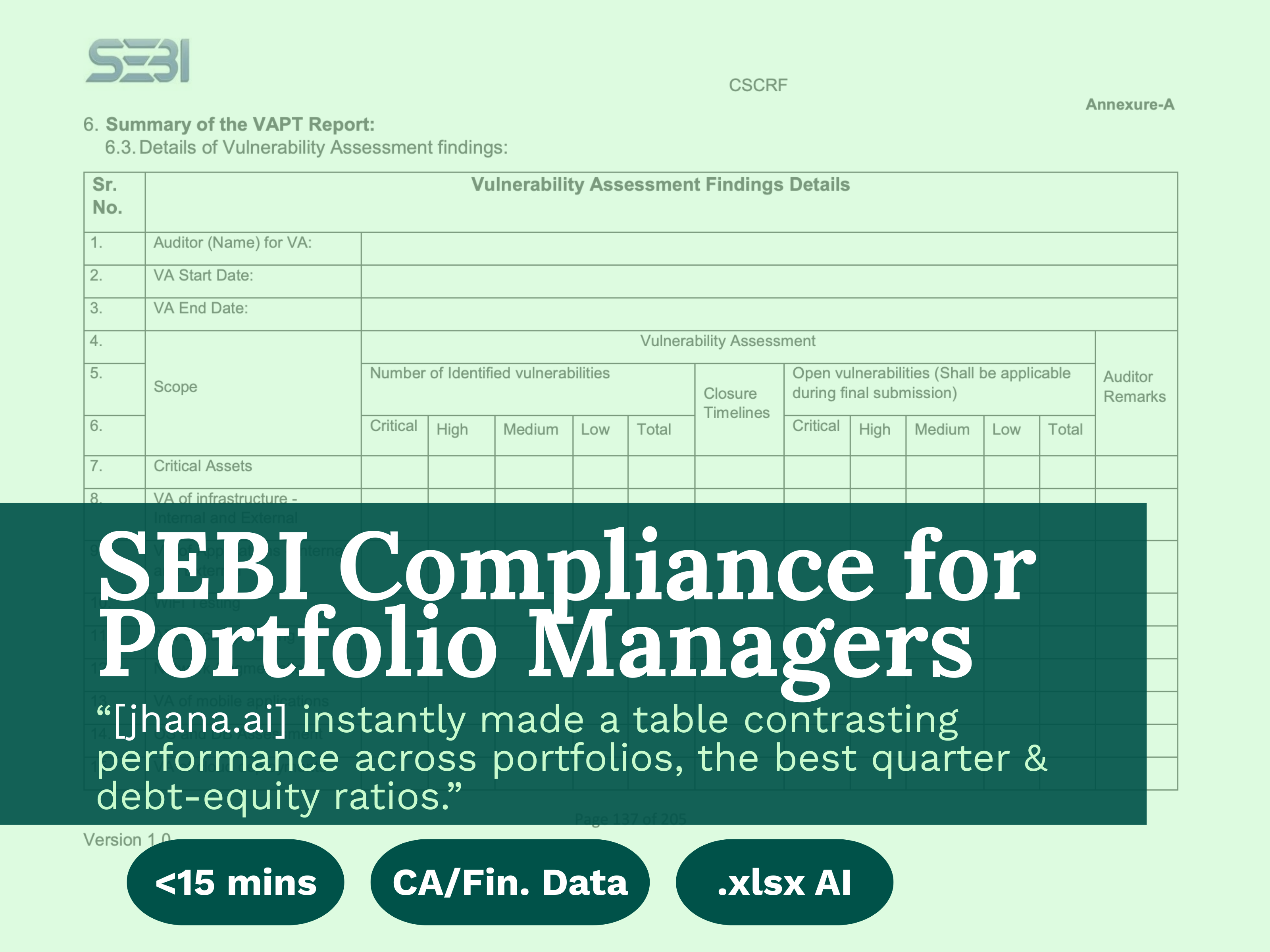
"It instantly generated a table contrasting the performance across different portfolios as well as highlighting the best quarter and the growth over time. Suit was also able to generate the debt‑equity ratio within the portfolio."
Sunil Nahar
Founder, Common Wealth Advisors
Headnote
Fragmented portfolio documents (FD statements, PF passbooks, brokerage reports) converted into instant, source-linked analytics tables. Debt-equity ratios, quarterly performance, and best-quarter highlights extracted in minutes with full regulatory compliance trail.
How to Run Portfolio Reviews on Suit
Running a portfolio review on jhana Suit takes three steps. Each conclusion is one click away from the underlying source page.
01
Upload Documents As-Is
Upload PDFs and spreadsheets: FD statements, PF passbooks, insurance policies, brokerage reports. Suit parses tables, dates, and securities/allocations automatically.
02
Automatic Extraction & Tabulation
The system extracts portfolio values, dates, and allocations. Tabulate builds comparative tables by portfolio and quarter, computes deltas, and surfaces the best quarter automatically.
03
Source-Linked Notes & Ratios
Every figure is anchored to page and paragraph with a traceable link. Debt-equity ratios, growth over time, and top-performing quarters.
Feature: Notes
Inline date recognition and portfolio mapping with page-linked citations
Feature: Tabulate
Per-portfolio grid showing: quarter, value, delta, growth %, debt-equity ratio, best quarter highlight
Feature: Preview
Verify against the original document with synchronized highlighting; click any footnote to jump to source
 Play from Vimeo 2:08
Legal Framework
Wealth management teams face fragmented artifacts (FD statements, PF passbooks, insurance policies, brokerage reports), making on-call consolidation slow and error-prone. Regulatory exposure arises across multiple dimensions: client reporting, record-keeping, AML/KYC traceability, and cyber security.
1. SEBI (Portfolio Managers) Regulatory Duties
Portfolio managers must maintain client-wise accounts, furnish periodic reports (not exceeding six months), preserve records for minimum five years, and submit to inspections.
Reg. 17, 19, 21 • SEBI (Portfolio Managers) Regulations
2. Personal Data and Security
Section 43A • IT Act, 2000
Section 8(5)-(6) • DPDP Act, 2023
Key Supreme Court Authorities
The following judgments establish the evidentiary framework for electronic records, critical for any AI-generated portfolio analysis that may be produced in proceedings.
Anvar P.V. v. P.K. Basheer
(2014) 10 SCC 473 • Supreme Court of India (2014)65A/65B is the special code for electronic records. Any electronic record sought to be admitted must comply with Section 65B.
Arjun Panditrao Khotkar v. Kailash Kushanrao Gorantyal
(2020) 7 SCC 1 • Supreme Court of India (2020)65B certificate is mandatory unless the original device/primary electronic record is produced. Clarifies exceptions for when the device is not under the party's control.
Regulatory Compliance Mapping
The source-linked workflow maps directly to regulatory obligations:
- SEBI Reg. 21 client reporting: Completeness and clarity in composition, transactions, cash balance, and risk disclosures
- SEBI Reg. 17/19 record-keeping: Structured, searchable preservation for ≥5 years
- Master Circular audit-readiness: Performance benchmarking and firm-level audit consistency
- AML/KYC trails: Evidence of origin, completeness, and monitoring
Before vs After: Compliance and Audit Posture
| Area | Legacy Process | AI-Powered (jhana) |
|---|---|---|
| Client Reporting | Manual collation; inconsistencies | Automated quarterly tables, deltas, best quarter |
| Record-keeping | Scattered files | Source-linked entries; page/para anchors |
| Performance Audit | Ad hoc spreadsheets | Consistent firm-level metrics; audit-ready |
| AML/KYC | Fragmented evidence | Traceable document lineage and checks |
| Data Protection | Undefined retention | Retention tagging; security safeguards |
Key Takeaway
Immediate, on-call clarity: Growth over time, top-performing quarters, and current debt-equity ratios, delivered with source-linked citations that satisfy SEBI reporting requirements, support AML/CFT audit trails, and produce 65B-compliant electronic evidence.
References
[1]
SEBI (Portfolio Managers) Regulations. Reg. 17, 19, 21: record-keeping, client reporting
[2]
Digital Personal Data Protection Act, 2023. Security safeguards, accuracy, breach intimation (s.8)
[3]
IT Act, 2000 Section 43A. Reasonable security practices; compensation for negligence
[4]
Anvar P.V. v. P.K. Basheer (2014). Section 65B is the special code for electronic records
[5]
Arjun Panditrao Khotkar (2020). 65B certificate mandatory unless original device produced