
Filing scrutiny time cut 83% on commercial e-filings.
Principal Commercial Courts, Chennai
A commercial suit in Chennai begins with a wait. Before a judge sees it, an officer checks it by hand against the registry’s list: the right court, the right fee, the right affidavits. That took an hour and a half a filing. In Telangana the same queue holds bail applications, and an undertrial spends three more days in custody, on average, while the papers are checked. “We have created a structure that quietly rewards procedural gamesmanship over substance,” jhana’s Anya Batra wrote in Bar & Bench. In 2025, under the High Court of Judicature at Madras, we put AI scrutiny on new suits at the Principal Commercial Courts in Egmore.
From 24 September to 21 October 2025 the system reviewed 10 freshly e-filed commercial suits. On each it ran five checks: jurisdiction, against Chennai’s territorial map; the particulars a plaint must carry under Order 7 Rule 1; court fees, against the Tamil Nadu schedule; the affidavits; and defects in the plaint and its annexures. Every finding pointed to the page it came from. An hour and a half of scrutiny became under 15 minutes: 83% less. Court officers took every decision, and all 10 filings were completed correctly. The pilot’s NPS was 5 out of 5. We reported the results to the High Court’s Registrar (Computers) on 4 November 2025.
What changes is who does what. For lawyers: defects in under 15 minutes, which they can cure immediately. For the registry: rote data entry becomes a human-in-the-loop verification role, and the court can redeploy officers to senior work it now drops, the kind that wastes weeks of court time when missed: caveat checks, triaging urgent matters, and detecting forum shopping. Nobody set out to build a forum-shopping detector. To check a suit, the system must decide what kind of dispute it is and which court should hear it; do that for every filing and the registry can see the same quarrel arriving twice, at the court most likely to favor it. A suspicion that used to surface months later, from opposing counsel, becomes a flag at the counter on day one.
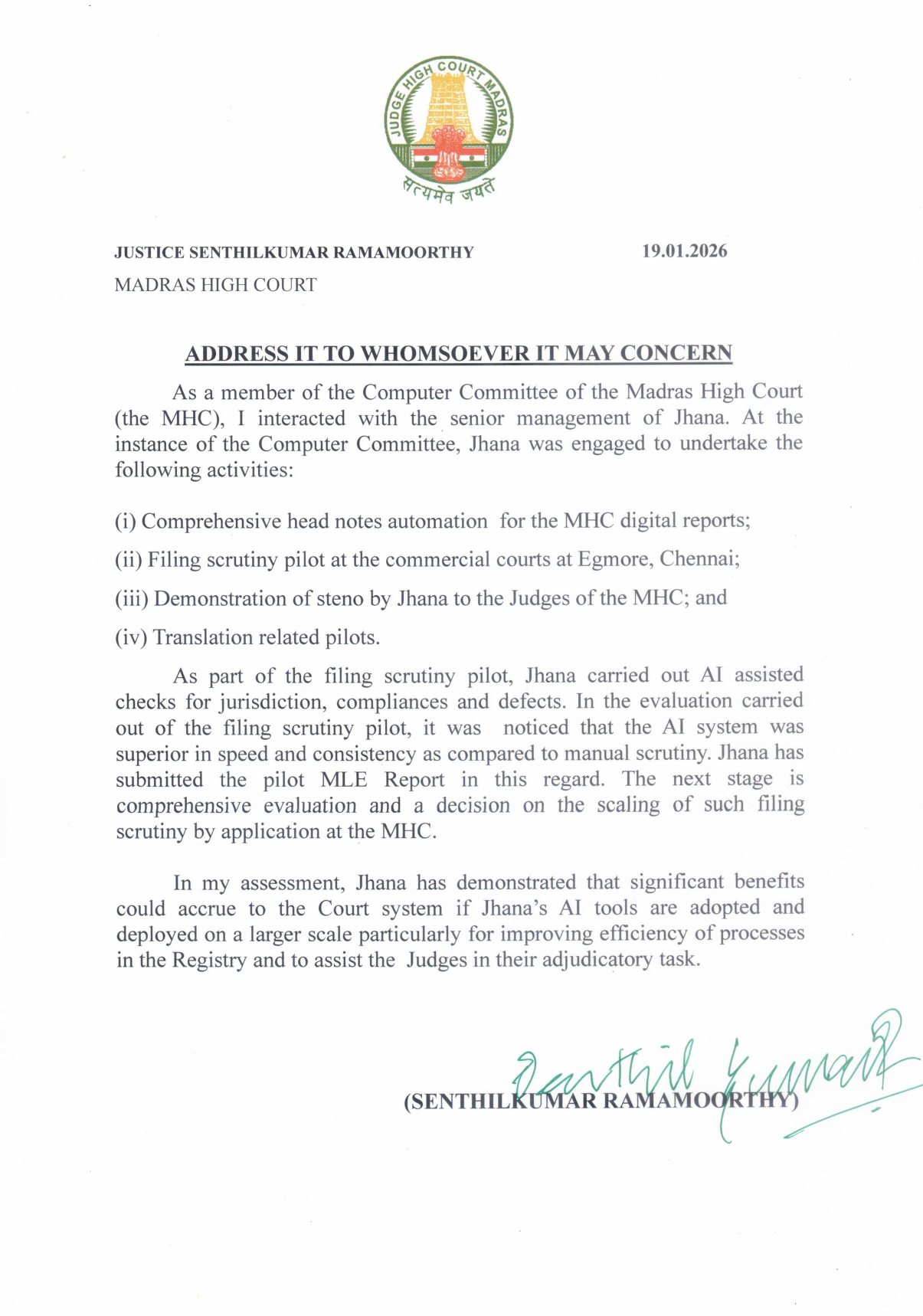
“In the evaluation carried out of the filing scrutiny pilot, it was noticed that the AI system was superior in speed and consistency as compared to manual scrutiny. … In my assessment, jhana has demonstrated that significant benefits could accrue to the Court system if jhana’s AI tools are adopted and deployed on a larger scale particularly for improving efficiency of processes in the Registry and to assist the Judges in their adjudicatory task.”
Hon’ble Mr. Justice Senthilkumar Ramamoorthy, Computer Committee, High Court of Judicature at Madras, in a letter of 19 January 2026
As seen in
